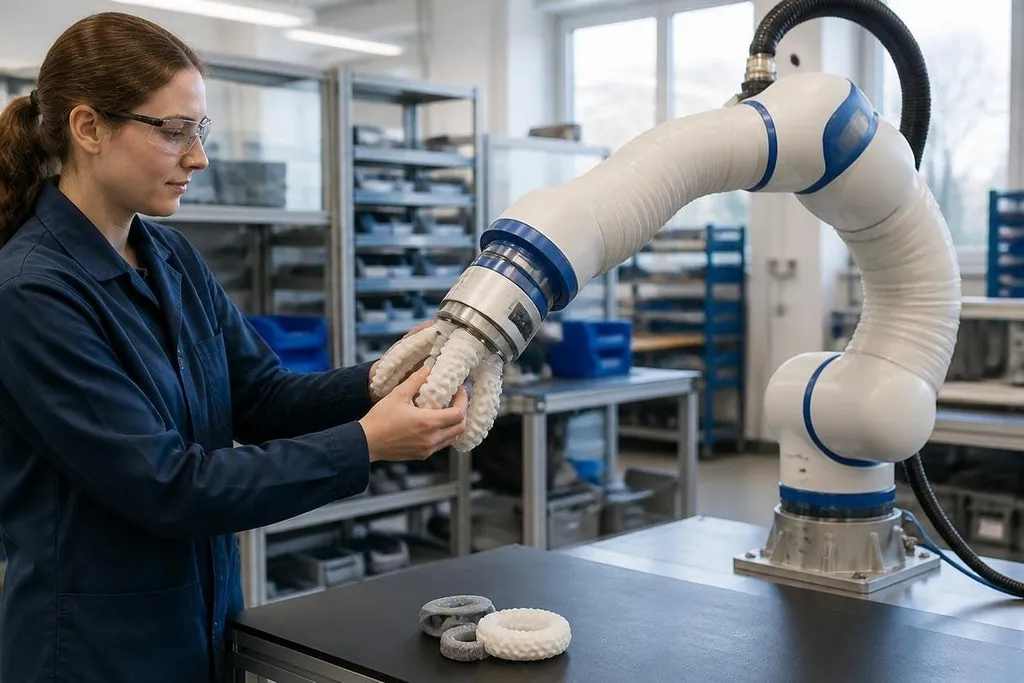
A soft robot can bend, deform, and spread contact across a human body. That makes a collision less severe than a hard metal link, but the material alone doesn't make the system safe.
For a technician sharing a work area with automation, safe operation depends on the robot's shape, its sensors, and the rules that stop it when conditions change.
- Soft materials reduce sharp contact points
- Force sensing can detect an unexpected touch
- Safe work still needs limits, tests, and clear restart rules
What makes a robot soft
Soft robots use flexible materials or compliant parts that bend under load. A gripper made from silicone, for example, can wrap around an object instead of holding it with rigid fingers and a fixed shape.
That change affects the contact between robot and person. A flexible surface can spread force over a wider area, while a rigid edge can focus force into a small point.
The effect depends on the material, the robot's speed, the object it carries, and the pressure inside any pneumatic actuator.
These robots can still contain rigid motors, frames, valves, batteries, or control boards. Those parts may create hard contact points even when the outer body looks flexible. A safety review has to cover the whole machine.
Three layers of safe operation
The first layer is mechanical. Rounded edges, flexible skins, low-mass moving parts, and compliant joints reduce the harm from contact. A soft gripper also needs a limit on how far it can close, since flexible material can still squeeze a finger or crush a fragile object.
The second layer is sensing. Force sensors can detect contact at a joint or gripper. Pressure sensors can watch a pneumatic chamber. Cameras and proximity sensors can help the robot detect a person before contact, but each sensor has blind spots and needs a clear response when its signal looks wrong.
The third layer is control. The robot can slow down near people, stop when force rises past a set limit, and require a deliberate restart after a safety stop. These rules matter because a sensor has little value if the control system keeps the motor moving after it detects contact.
A safe design also gives people a clear way to stop the machine. An emergency stop should be easy to reach from the normal work position, and the robot should not restart when power returns unless a person starts it again.
Where soft robots still have limits
Soft materials make control harder. A rigid arm has a fairly stable shape, while a flexible body may bend differently under changing loads. That can make its position and force harder to predict, especially when it handles an object with an unknown weight or shape.
Wear creates another concern. A flexible skin can tear, lose pressure, or change its stiffness after repeated use. A small defect may affect grip force before it becomes easy to see, so inspection and pressure checks belong in the work routine.
Soft robots also need task limits. A gripper that handles fabric may work well beside a person, while the same design may be unsuitable for hot parts, sharp tools, or heavy loads. The safety case belongs to the full task, not to the word “soft” on a product page.
A soft shell can reduce contact force, but safety still depends on speed, payload, temperature, and the stop rule. Robot 24 can give you a named machine and test result to compare before the practical check below.
A practical check before shared work
Use this list when reviewing a soft robot for a task near people:
- Map contact points: Mark every rigid part, pinch area, hot surface, and moving edge.
- Set force limits: Choose limits for the person, object, gripper, and task rather than one limit for the whole machine.
- Test sensor failure: Disconnect or block each safety sensor and confirm that the robot stops or enters its safe state.
- Check the restart: Cut power, clear the work area, and verify that movement requires a deliberate command.
- Inspect the skin: Look for tears, leaks, worn seams, and changes in pressure before each work period.
- Train the operator: Explain the stop control, safe distance, inspection steps, and recovery process in plain language.
What to expect next
The useful measure won't be how soft a robot feels in a demonstration. It will be how the full system behaves after a sensor fault, a damaged actuator, an unexpected load, or a person stepping into its path.
I’d trust a soft robot beside people only when its mechanical design, sensing, control rules, and maintenance plan have been tested as one system. Until then, softness lowers one hazard while leaving the rest of the safety work to the team building and running it.